
A Good Body Paragraph

When you write strong, clear paragraphs, you are guiding your readers through your argument by showing them how your points fit together to support your thesis. The number of paragraphs in your essay should be determined by the number of steps you need to take to build your argument. To write strong paragraphs, try to focus each paragraph on one main point—and begin a new paragraph when you are moving to a new point or example.
Main Elements of a Strong Academic Paragraph
A paragraph is a sequence of sentences that support one central idea. It is a steppingstone on the way
to writing a paper. A strong paragraph will help the paper achieve its purpose, but a weak paragraph will detract from the effectiveness of the essay
The topic sentence (Point)
This should appear early in the paragraph and is often, but not always, the first sentence. It should clearly state the main point that you are making in the paragraph. When you are planning essays, writing down a list of your topic sentences is an excellent way to check that your argument flows well from one point to the next.
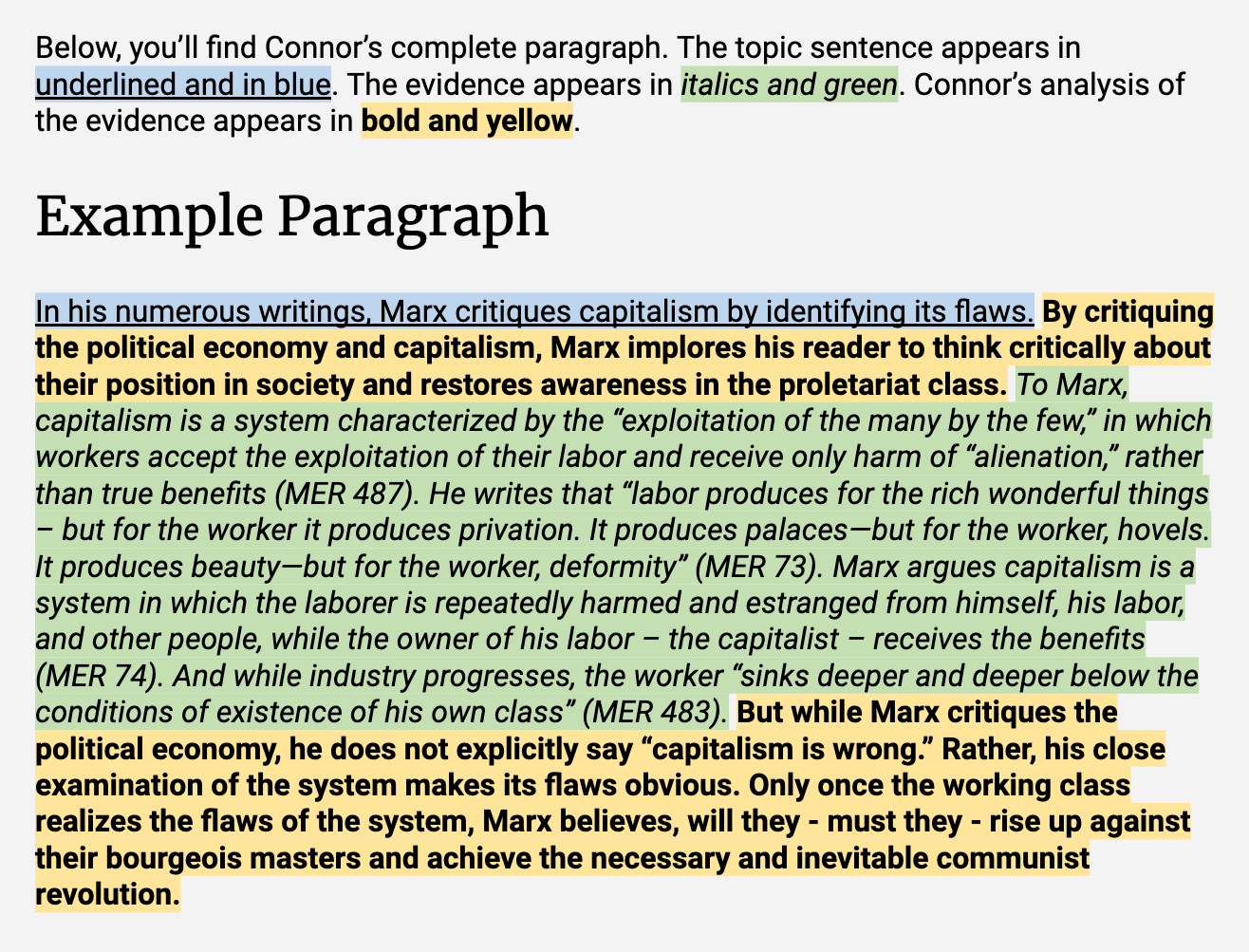
A topic sentence signals to your readers what idea is most important in that paragraph—and it also helps you know if you’ve effectively made your point. In this case, Connor has set up the expectation for readers that by the end of the paragraph, they will understand Marx’s view of the flaws in capitalism.
Evidence
This is the evidence that backs up your topic sentence. Why do you believe what you have written in your topic sentence? The evidence is usually paraphrased or quoted material from your reading. Depending on the nature of the assignment, it could also include:
- Your own data (in a research project for example).
- Personal experiences from practice (especially for Social Care, Health Sciences and Education).
- Personal experiences from learning (in a reflective essay for example).
Any evidence from external sources should, of course, be referenced.
Explanation (analysis)
This is the part of your paragraph where you explain to your reader why the evidence supports the point and why that point is relevant to your overall argument. It is where you answer the question 'So what?'. Tell the reader how the information in the paragraph helps you answer the question and how it leads to your conclusion. Your analysis should attempt to persuade the reader that your conclusion is the correct one.
And introducing a new point in the final sentence can confuse readers by leaving them without evidence to support that new point. Instead, try to end your paragraph with a sentence that tells readers something that they can now understand because they’ve read your paragraph.
Length of a paragraph
Academic paragraphs are usually between 100 and 200 words long (they vary more than this but it is a useful guide). The important thing is that they should be long enough to contain all the above material. Only move onto a new paragraph if you are making a new point.
Example of an Academic Paragraph
SOME USEFUL TRANSITIONS
Transitions help your readers move between ideas within a paragraph, between paragraphs, or between sections of your argument. When you are deciding how to transition from one idea to the next, your goal should be to help readers see how your ideas are connected—and how those ideas connect to the big picture.
Making a comparison or showing a contrast
Transitional words that compare and contrast include also, in the same way, similarly, in contrast, yet, on the one hand, on the other hand. But before you signal comparison, ask these questions: Do your readers need another example of the same thing? Is there a new nuance in this next point that distinguishes it from the previous example? For those relationships between ideas, you might try this type of transition: While x may appear the same, it actually raises a new question in a slightly different way.
Expressing agreement or disagreement
When you are making an argument, you need to signal to readers where you stand in relation to other scholars and critics. You may agree with another person’s claim, you may want to concede some part of the argument even if you don’t agree with everything, or you may disagree. Transitional words that signal agreement, concession, and disagreement include however, nevertheless, actually, still, despite, admittedly, still, on the contrary, nonetheless.
Drawing conclusions
You can use transitions to signal to readers that you are moving from the body of your argument to your conclusions. Before you use transitional words to signal conclusions, consider whether you can write a stronger conclusion by creating a transition that shows the relationship between your ideas rather than by flagging the paragraph simply as a conclusion. Transitional words that signal a conclusion include in conclusion, as a result, ultimately, overall—but strong conclusions do not necessarily have to include those phrases.
Explaining or elaborating
Transitions can signal to readers that you are going to expand on a point that you have just made or explain something further. Transitional words that signal explanation or elaboration include in other words, for example, for instance, in particular, that is, to illustrate, moreover.
Showing cause and effect
Transitional phrases that show cause and effect include therefore, hence, consequently, thus, so. Before you choose one of these words, make sure that what you are about to illustrate is really a causal link. Use those words when they accurately signal the progression of your ideas.
To show time
Transitions that show time include after, afterward, as, as long as, as soon as, at last, before, during, earlier, finally, formerly, immediately, later, meanwhile, next, since, shortly, subsequently, then, thereafter, until, when, while. Use these terms to indicate temporal order accurately within your writing and clarity.