
Dissertation Guidelines

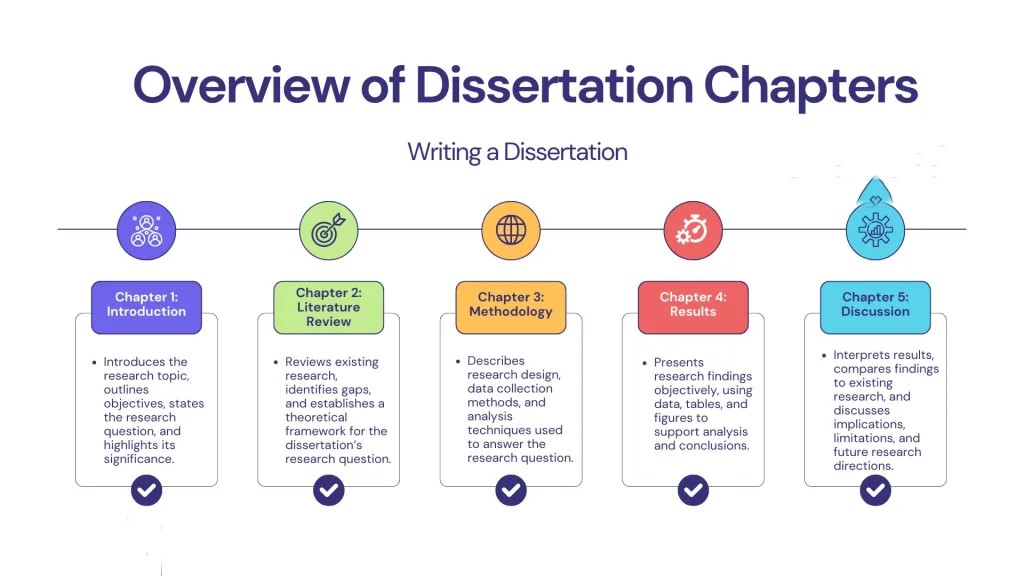
How to Write a Dissertation (Step-by-Step Guide)
These guidelines provide a framework for thorough presentation of your research. The discussion in
some parts of the chapters will differ for quantitative and qualitative research studies. The research
questions normally drive selection of the methodological approach(es) and design of the research.
CHAPTER 1: INTRODUCTION
The first chapter of a dissertation serves to introduce the project to your reader. Chapter 1 is the most important chapter because it’s the “nuts and bolts” of your project, laying the foundation for your entire study!
This chapter introduces and provides an overview of the research that is to be undertaken.
Parts of Chapter 1 summarize your Chapters 2 and 3, and because of that, Chapter 1 normally
should be written after Chapters 2 and 3. Dissertation committee chairs often want students
to provide an 8–15-page overview of their proposed “dissertation research” before undertaking
a full literature review and detailed development of the methodology.
Some may call this a “prospectus” and some may call it a first draft of Chapter 1. Whatever the terminology, the final draft of your Chapter 1 is to include accurate summaries of the final drafts of your Chapters 2 and 3. It is important to undertake preliminary examinations of the literature before finalizing the problem and research questions of your proposed research. Exploration of the literature sometimes reveals that your initially chosen focus has already been extensively researched.Contradictory results may offer you an opportunity to do research that clarifies the reasons for the contradictions. If the results consistently support or contradict your expectations, you will probably have to find other research questions that have not yet been well researched.
Note: The items listed below are not intended to be headings in the dissertation, but simply outline the elements that are included in a typical dissertation.
1-A. Overview
Briefly explain why the study is being undertaken and what main questions or foreshadowed problems will be addressed. Do this in a general manner, because it will be done more specifically in the following sections.
1-B. Statement of the Problem
Discuss the problem to be addressed in the research— the gaps, perplexities, or inadequacies in existing theory, empirical knowledge, practice, or policy that prompted the study. The problem may be a theory that appears inadequate to explain known phenomena, the lack of empirical data on a potentially interesting relationship between X and Y, or a common practice that appears ineffective. First state the problem generally, and then state the specifics that your research will address. In quantitative research, the specifics will include the constructs studied.
That your favorite reading program is rarely used in schools does not constitute a problem; widespread impaired reading in inner-city elementary schools is a problem. That your favorite conjectures are not represented in prevailing theory does not constitute a problem; that the theory does not explain applicable phenomena is a problem. That a certain group has been omitted from prior studies can indeed constitute a problem, because theory, policy and practice have not been shaped by knowledge of that group.
Problems usually have underlying causes that may be well-known or the subject of speculation. They also have consequences that are often apparent. You should briefly discuss these causes and consequences.
1-C. Purpose
The purpose of research is to acquire knowledge to address the problem or certain aspects of it. Quantitative research tries to fulfill that purpose by answering questions and/or testing hypotheses. Qualitative research tries to fulfill that purpose by starting with foreshadowed problems, conjectures, or exploratory questions. Mixed-methods research may use both approaches.
1-D.1 Research Questions or Hypotheses
Research questions address problems of the study. Each research question seeks answers to a specific problem situation described in your study. The type of the data and its availability determine the research questions. For instance, research questions should relate to the conceptual framework. Each question should address and target a separate problem situation.
A good hypothesis clearly states the expected relationship (or difference) between two variables and defines those variables in operational, measurable terms. The hypothesis (or hypotheses) logically follows the review of related literature and is based on the implications of previous research. A well-developed hypothesis is testable, that is, can be confirmed or dis-confirmed. The qualitative researcher is unlikely to state hypotheses as focused as those of a quantitative researcher, but may have and express some hunches about what the study may show.
1-D.2. Significance of the Study
Discuss the potential significance of the research. Significance comes from the uses that might be made of your results—how they might be of benefit to theory, knowledge, practice, policy, and future research. The potential significance should be based upon your literature review in Chapter 2.
1-E. Theoretical or Conceptual Framework
Briefly summarize the theoretical foundation or conceptual framework(s) derived from the literature review that is reported in Chapter 2. Conceptual framework is the theoretical foundations helping us understand the problem situation and its dynamics. It includes your study variables and depicts the established or predicted relationship(s) among these variables. You may adopt an existing conceptual framework or develop your own modified version based on the literature review.
Quantitative Research:
Research Questions and/or Hypotheses (Present the research hypotheses stated fully— exactly as you state them in Chapter 3.)
Qualitative Research:
Foreshadowed Problems, Conjectures, or Exploratory Questions (Present the foreshadowed problems, conjectures, or exploratory questions stated in 3-B below. State them fully— exactly as you state them in Chapter 3.)
1-F. Summary of Methodology
Briefly summarize the methodology of the research that is described fully in Chapter 3.
1-G. Limitations
All studies have limitations to their internal validity, generalizability, and applicability. The researcher has no control over limitations. You have a responsibility to forewarn readers of the limitations and the reasons for them. Some limitations arise from the delimitations of the study—boundaries to make the study manageable, such as studying only one sub-population of interest, addressing only parts of a problem, or perhaps examining only short-term effects. Some limitations arise from accommodating ethical concerns. Others come from shortcomings in methodology.
1-H. Definition of Terms
Briefly define key terms in the research that might not be well understood by the readers. Cite a source for each definition derived from the literature. It is acceptable for this section as well as sections 1-E and 1-G to appear in other chapters of the dissertation.
CHAPTER 2: LITERATURE REVIEW
This chapter is your literature review, and it’s is designed to do three things: 1) conceptualize your research, 2) expose the gap your study will address, and 3) test your resolve. On average, a literature review is 30-50(ish) pages dedicated to discussing what’s known and unknown, relative to your topic. Take a funnel approach to the literature review – work from the broad to the specific and focus on the research most relevant to your topic.
Scholarly research is always a leap from the known to the unknown. The literature review and conceptual framework are used to construct a platform of the known from which you jump. Constructed carefully, the literature review and conceptual framework can maximize the chances of your spanning the abyss and reaching something substantive when you land. Constructed carelessly, they can undermine your research.
The literature review should carefully examine prior research and thought relevant to key aspects of your anticipated research. It should be used to inform:
- The problem to be addressed and its significance
- The theoretical foundation or conceptual framework
- The research questions, hypotheses, foreshadowed problems, or conjectures
- The research paradigm and the methodology
The subsections indicated below are of the process and components of a literature review and not necessarily subheadings of Chapter 2.
2-A. Introduction: Topic(s), Purposes, and Methods of the Literature ReviewA literature review usually begins with an indication of the topic(s) to be covered and the purposes of the review. The methods of the review should be briefly described. Indicate the indices and other methods used to search for applicable literature, the terms searched with each, and the years searched (usually the last ten or twenty years, plus key literature from earlier years). A review should address each topic highly applicable to the problem. For problems that are not well researched, the literature review may also address other topics that are tangentially related and might help inform the study. If the literature on a topic is voluminous—it is not uncommon to find more than 100 studies—you should be selective, covering the literature most applicable to the focus of your proposed research, as indicated by the research questions, hypotheses, foreshadowed problems, or conjectures. Consult with your advisor before beginning the literature search to make sure you are covering the topics and years of research that he or she thinks are appropriate.
2-B. Description and Critique of Scholarly Literature: Each major theoretical discourse, conceptual discussion, and empirical study should be described and critiqued briefly. Both the strengths and weaknesses should be identified. For theoretical discourses, indicate the source of the theory, overlaps and disparities with other applicable theories, and whether and how well the theory has been empirically verified. For conceptual discussions, indicate the sources of the concepts, overlaps and disparities with other applicable concepts, and whether and how well the concepts have been empirically verified. For empirical studies (including qualitative ones) indicate the research questions, methodological strengths and weaknesses, results (both their magnitude as well as their statistical significance or extent of cross-verification), conclusions, and implications. It is important to note that a scholarly review of the literature should focus on primary sources such as refereed journal articles rather than secondary sources such as course textbooks. Organizing the written review can be a challenge because the review has several simultaneous purposes. Often the best strategy is to organize the studies under major topics, theories, constructs, research questions, or methodologies. When a given study addresses more than one organizational category, you might critique it under the first applicable category, and then briefly refer to it under each subsequent applicable category. Alternatively, in the subsequent organizational categories, you might extend the critique as appropriate for that category. When considerable literature falls within one organizational category, it might be organized within second level categories. Otherwise the description and critique of literature might be presented chronologically. Lesser literature sometimes can be described and critiqued jointly, for instance, by indicating, “Several other smaller studies found (Anderson, 1995; Baxter, 1992, Castro; 1999).” You should avoid creating a biased review that only covers prior literature that supports your predispositions and disregards other literature. Similarly you should consistently critique the literature. Do not ignore weaknesses in studies supporting your predispositions and do not be hypercritical of studies that contradict your predispositions. Failure to conduct a fair-minded review is likely to compromise your research.
2-C. Inferences for Forthcoming StudyOnce you have described and critiqued the individual sources, you should analyze and synthesize across them to draw inferences applicable to your anticipated research. The inferences generally should be about:
- The problem and its significance
- Possible research questions, hypotheses, or conjectures
- Potential conceptual or theoretical frameworks
- Possible research paradigms and methodologies
The inferences might be stated at the end of each major topic of your review or after all the relevant topics have been discussed. The following questions may generate useful inferences: What does the literature state about the extent of the problem, its underlying causes, where it is most and least severe, and its consequences for theory, knowledge, practice, policy and/or research? How have results of empirical studies varied according to the questions/hypotheses/conjectures that have been addressed? What conceptual frameworks have been applied and with what insights? How might the conceptual frameworks be modified or synthesized to provide new insights to this problem? Which research paradigms and methods have yielded the strongest results and which the weakest results, and why?
2-D. Theoretical/Conceptual Framework for Forthcoming Study (May appear in Chapter 3.)The problem and research questions, hypotheses, foreshadowed problems, or conjectures were explained above under Chapter 1, but the “theoretical framework” or “conceptual framework” has not yet been explained. These are a theory or set of interrelated constructs that provide perspective or “lens” through which the research problem is viewed and through which the choices about the research will be made. They help narrow down and focus the research. Note that a theoretical or conceptual framework works like a telescope or microscope, and thus it both enhances what you can see and also restricts your breadth of vision. For that reason, a conceptual framework should be used judiciously to help inform your study rather than to dictate all aspects of it. Sometimes important breakthroughs occur when a researcher abandons the commonly-used conceptual framework and applies one never before used with a given problem.
CHAPTER 3: RESEARCH DESIGN AND METHODOLOGY
The third chapter is the most formulaic of the dissertation: your methods chapter. In Chapter 3, you provide a blueprint of what you’re going to do. Think of it this way: (1). Chapter 1 explains what your study is about and why it’s important; (2). Chapter 2 highlights what’s known, what remains unknown, and how your study will address the knowledge gap; and (3). Chapter 3 details exactly how you intend to perform your research to address that gap.
The methods are the procedures used to acquire empirical evidence and analyze it for purposes of answering research questions, testing hypotheses, and examining foreshadowed problems, following up on conjectures, and going forward from exploratory questions. The choice of methodology should be made in light of the literature review and with careful deliberation. Small oversights can sometimes undermine a long and difficult study. Your committee will help you think through the appropriateness of proposed methods and will probably suggest some refinements.
Your approved proposal is considered a blueprint for research. You are expected to do everything indicated in that blueprint. In experimental research, it is usually expected that no changes will be made unless you encounter unanticipated problems that require modifications. In other quantitative research, such as quasi-experimental, longitudinal and secondary data analysis, additions over and beyond the blueprint may be appropriate to deal with unanticipated opportunities. In qualitative research, the proposal outlines the broad parameters of the study, but usually several details are expected to be decided during the actual data collection and analysis. Changes in the planned research should be made only after consultation with your full dissertation committee. Changes in the collection and handling of data from humans will generally require re-submission for IRB approval.
A few important aspects of the methods cannot be known until after the study has been conducted, such as the response rates from samples, errors or accidents in carrying out the planned methods, and whether the collected data meets the assumptions of the planned statistical analyses. Consequently, whatever is written in the research proposal about methodology may have to be updated when preparing Chapter 3 of the dissertation.
The subsections indicated below are the components of the methodology and not necessarily subheadings of Chapter 3. Mixed-methods studies may benefit from the guidelines below for both quantitative research and qualitative research.
3-A. Methodology Briefly re-introduce the problem and provide an overview of the methodological approach.
3-B. Conjectures, or Exploratory Questions State the conjectures or exploratory questions that guided the inquiry. The conjectures or exploratory questions can be descriptive, associational, and causal. Qualitative research answers questions in a holistic manner based on multiple sources of information and cross-verification.
3-C. Research Procedures Describe in detail how the inquiry was undertaken so other skilled researchers could approximately replicate your study.
- a) Introduce the epistemology that will guide the inquiry.
- b) Explain the theoretical perspective driving the research and why it was selected.
- c) Indicate the methodology used and why it was selected.
- d) Indicate the specific methods used and the justification for them. Include: — site/case/informant selection — access attempts — who avoided or pursued contact — how data was collected — verification procedures — bias protections — interview guides/protocols/rubrics (append as needed)
- e) Indicate how qualitative data was managed (notes, recordings, excluded data, etc.).
- f) Indicate how data was analyzed and interpreted (themes, coding system, reliability checks, triangulation, interpretation methods).
3-D. Human Participants and Ethics Precautions Summarize potential human risks and precautions taken to ensure informed consent and minimize risk. Point to relevant IRB materials. Address additional ethical considerations such as conflicts of interest and personal biases. Reminder: IRB approval is required **before** beginning any data collection from or about humans.
CHAPTER 4: RESULTS or FINDINGS
After the first three chapters of your dissertation are approved and you’ve secured necessary research permissions (IRB, HRSC, etc.), you’ll collect and analyze your data. The results of your analysis are presented in Chapter 4.
Data analysis, whether quantitative or qualitative, summarizes large amounts of information to answer research questions, test hypotheses, examine foreshadowed problems, and explore conjectures. Results are typically reported in Chapter 4 and interpreted in Chapter 5. Even in qualitative studies—where analysis and interpretation are intertwined—Chapter 4 should focus on low-level interpretations, saving higher-level insights for Chapter 5.
The chapter should tell a coherent story, highlight major findings, and present less important results briefly. Avoid overwhelming the reader with excessive statistics—important results should be placed in tables, charts, or graphs, then explained clearly.
When determining which results are most important, consider:
- (a) The epistemology, theoretical foundation, or conceptual framework used in the study
- (b) The main questions, hypotheses, or conjectures
- (c) The magnitude, statistical significance, or cross-validation of findings
- (d) Consistency of results across multiple measures or similar constructs
- (e) Implications for theory, knowledge, practice, policy, and future research
Standardizing Terminology Ensure key terms are used consistently. Synonyms may confuse readers if they suggest different meanings. Results must be reported in enough detail to justify conclusions in Chapter 5.
4-B. Text The text should emphasize the most important findings and report minor results briefly. For example, if demographic analyses produced no significant relationships, a single summary sentence may be sufficient. Note response rates and item-completion rates for each data-collection effort.
4-C. Reporting Statistics Means should nearly always include standard deviations and sample sizes. Major results should report both p-values and effect sizes (omega squared, r squared, mean differences, etc.). When non-significant results occur, address whether insufficient statistical power may have obscured true effects.
4-D. Tables, Graphs, and Charts Tables condense information but may overwhelm readers, so emphasize essential points in the text. Graphs and charts naturally highlight main findings when kept simple. Always introduce each table or graph in the text and follow it with clarification or interpretation.
4-E. Raw Data Raw data from individuals is usually not included unless the sample is small. Illustrative quotes may be used if they align with Informed Consent protections. Complete datasets that fit within a few pages may be placed in an Appendix. APA guidelines require raw data to be stored for at least five years and made available for reanalysis.
CHAPTER 5: CONCLUSIONS, INTERPRETATIONS AND RECOMMENDATIONS
Chapter 5 – you made it! This is the most fun chapter to write because you have the most freedom in Chapter 5. The goal of your discussion chapter is to interpret the results and answer the SO WHAT question.
This chapter gives meaning to the results by connecting them to past theory, research, policy, and practice, and by extrapolating them to future theory, research, policy, and practice. Chapter 5 requires imagination and boldness—but always with scholarly caution. Conclusions and recommendations must be grounded in your study and strengthened by prior literature.
Chapter 5 is often the weakest chapter in first drafts because students are tired and rushing to finish. It requires a mindset shift: Chapters 2–4 narrow the focus, while Chapter 5 broadens it again.
Before writing Chapter 5, take several days off after finishing Chapter 4. Then read these guidelines, plus your Chapter 1 (problem, significance, limitations), Chapter 2, Chapter 4, and your notes about points to discuss in Chapter 5.
5-A. Summary Begin with a brief summary of the problem addressed and the main results. State whether the hypotheses were supported.
5-B. Conclusions Interpret the results in light of:
- The full set of findings
- Applicable literature
- The theoretical foundation or conceptual framework
- Study and literature limitations
Levels of Certainty Differentiate between:
- What is known with strong evidence
- What is suggested tentatively
- What was not learned
Interpretation Statistically significant and large results are straightforward to interpret. Statistically significant *small* results are often misinterpreted—they may be trivial in practical terms. Statistical significance does **not** mean importance. Small significant results may still matter for theory or management, but not as grounds for major programmatic decisions. Non-significant results may reflect low statistical power rather than absence of real effects. For qualitative research, the same principles apply: evaluate the *magnitude* and *importance* of insights.
5-C. Recommendations Recommendations should be grounded in:
- Study results
- Applicable literature
- Study and literature limitations
- Policy
- Practice
- Theory
- Future research
- New problems discovered
- New research questions
- Promising or unsuitable methodologies
- Conceptual frameworks that deserve further testing