
The Beginner's Guide to Writing a General Essay
The university is a place of many different faculties and departments, and for each faculty or department there are different expectations for the focus, purpose, format, and structure of your paper. To ensure that you are adequately fulfilling those expectations, you will want to talk to your professor or T.A. However, as a general guideline, you can refer to this handout when organizing the content of your essay.

An essay is a piece of writing that is written to convince someone of something or to
simply inform the reader about a particular topic. In order for the reader to be convinced or adequately informed, the essay must include several important components to make it flow in a logical way. The main parts (or sections) to an essay are the intro, body, and conclusion. In a standard short essay, five paragraphs can provide the reader with enough information in a short
amount of space. For a research paper or dissertation, however, it is essential that more than five
paragraphs are present in order not to overwhelm the reader with too much information in one paragraph
Preparation for writing a general essay
Before you start writing, you should make sure you have a clear idea of what you want to say and how you’re going to say it. There are a few key steps you can follow to make sure you’re prepared:
- Understand your assignment: What is the goal of this essay? What is the length and deadline of the assignment? Is there anything you need to clarify with your teacher or professor?
- Define a topic: If you’re allowed to choose your own topic, try to pick something that you already know a bit about and that will hold your interest.
- Do your research: Read primary and secondary sources and take notes to help you work out your position and angle on the topic. You’ll use these as evidence for your points.
- Come up with a thesis: The thesis is the central point or argument that you want to make. A clear thesis is essential for a focused essay—you should keep referring back to it as you write.
- Create an outline: Map out the rough structure of your essay in an outline. This makes it easier to start writing and keeps you on track as you go.
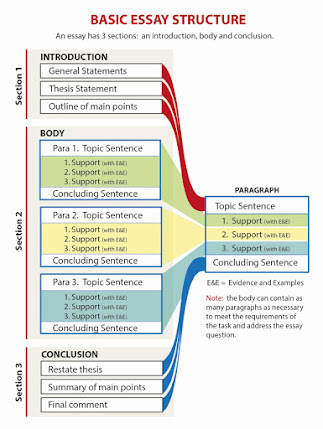
The followings are a brief description of each general essay element.
As stated in The Nature, History, and Types of Essay, an essay is a prose non-fiction piece of writing with a varying length that addresses a thing, a person, a problem, or an issue from the author's personal point of view.
INTRODUCTION
Writing an introduction can be the most difficult part of your assignment because it is where you lay out everything you will cover in what follows. The purpose of an introduction is to clearly tell the reader about the main themes and concepts in your assignment, as well as how you are going to approach them. Key to academic writing are clarity and predictability so the introduction should act as a signpost, or an essay map; after reading the introduction, the reader should understand what your essay will be about, what you are going to say, and what conclusion you will reach. The structure we suggest below will help you include and organise the key information.
The 'funnel' introduction has three distinct sections, moving from general to specific information, and guides the reader through your main argument:
General or Contextual Information:
This is where you give the background information that relates to your assignment question. You can concentrate on the broad themes that you will establish, perhaps by giving some key facts (statistics, for example) that will act as a 'hook' to interest the reader. This section is about contextualising the information you are going to discuss in the next part of your introduction.
Definitions and Key Concepts:
This part of your introduction will orientate your reader. You will need to introduce the key concepts that form the basis of your argument and let the reader know how these are related to the themes you introduce in the first part of the introduction. It might be useful to think about this section of the introduction as signalling to the reader what steps you will take to discuss those themes.
Thesis Statement:
This section will form the end of your introduction and will provide the detailed 'essay map' for your reader. You will make the main claim of your essay in the thesis statement (that is, what is the main conclusion you will reach), and you will outline the steps you are going to take to reach that conclusion (that is, what is the development of your main argument).
MAIN BODY
The paragraphs in the main body of your assignment act as building blocks for your argument. This means that their structure is crucial for enabling your reader to follow that argument. Just as the overall structure of your assignment has a clear beginning, middle, and end, so does each paragraph. You will usually see this structure referred to as the 'topic sentence', the 'supporting sentences', and the 'summary sentence'.
Topic Sentences
The topic sentence (sometimes called the 'paragraph header') outlines what the reader can expect from the rest of the paragraph; that is, it introduces the argument you will be making and gives some indication of how you will make it. Another way to think about this is that the topic sentence tells the reader what the theme of the paragraph will be (the main idea that underpins the paragraph) and outlines the lens through which you are going to explore that theme (what you are going to say about your main idea).
It is useful for you to check that each of your topic sentences is linked in some way to the thesis statement contained in your introduction. Are you following the ideas you laid out in your thesis statement? By referring back to the thesis statement, you can make sure that your argument remains focused on answering the question (rather than drifting) and that you are covering the information you introduced at the beginning of the assignment. In some cases, the topic sentence may not introduce an argument. This occurs when the purpose of the paragraph is to provide background information or describe something. This is okay too, as long as the content of the paragraph is needed to support your thesis statement in some way.
Tip: The topic sentence may not be the first sentence in the paragraph if you include a linking sentence to your previous paragraph, but it should definitely be placed close to the start of the paragraph.
Supporting Sentences
The supporting sentences are where you put together your main argument. They develop the idea outlined in the topic sentence and contain your analysis of that idea. Your supporting sentences will usually contain your references to the literature in your discipline which you will use to build your own argument. You may also include facts and figures, counter arguments, and your judgements on how useful the literature is for your topic.
CONCLUSION
The conclusion should be easy to write because you do not have to discuss any new information (in fact, you should not introduce any new points in this part of your assignment). In reality, though, it can be a struggle to decide what to include in your conclusion. Using the framework in the diagram can help you effectively bring your argument to a close. This is an inverse structure of your introduction: in the conclusion you are moving from specific information to broader information.
In the 'Restate' section of a conclusion, it is a good idea to remind the reader of your thesis statement. You can paraphrase your thesis statement in order to remind the reader of the central claim of the assignment and how you set out to demonstrate this claim.
You can then broaden the discussion to provide a 'Recap' of your main argument. This does not mean repeating yourself; rather, you will give a brief synopsis of each part of your main argument, with a reminder of how it links to your main claim. This will help consolidate your argument in the reader's mind and confirm that you have answered your own thesis.
Finally, the 'Suggest' section can help you place your work within the wider scholarship of your discipline. You might, for example, make suggestions for further research based on gaps you have identified.
Why Conclusion Matter?
A conclusion is the final paragraph of your essay, but its job is much bigger than just saying “The End.”
Think of your essay as a great meal. The introduction is the appetizer. The body paragraphs are the main course. The conclusion? It’s the perfect dessert that leaves the reader satisfied and ties the whole experience together. A bad dessert can leave a weird taste, no matter how good the main course was.
Your conclusion serves three key purposes:
- It Provides Closure: It signals that the journey is over and resolves the main ideas.
- It Reinforces Your Argument: It’s your last chance to remind the reader of your thesis and show how your arguments proved it.
- It Shows the “Bigger Picture”: It zooms out to explain why your argument matters, connecting it to broader themes or the real world.